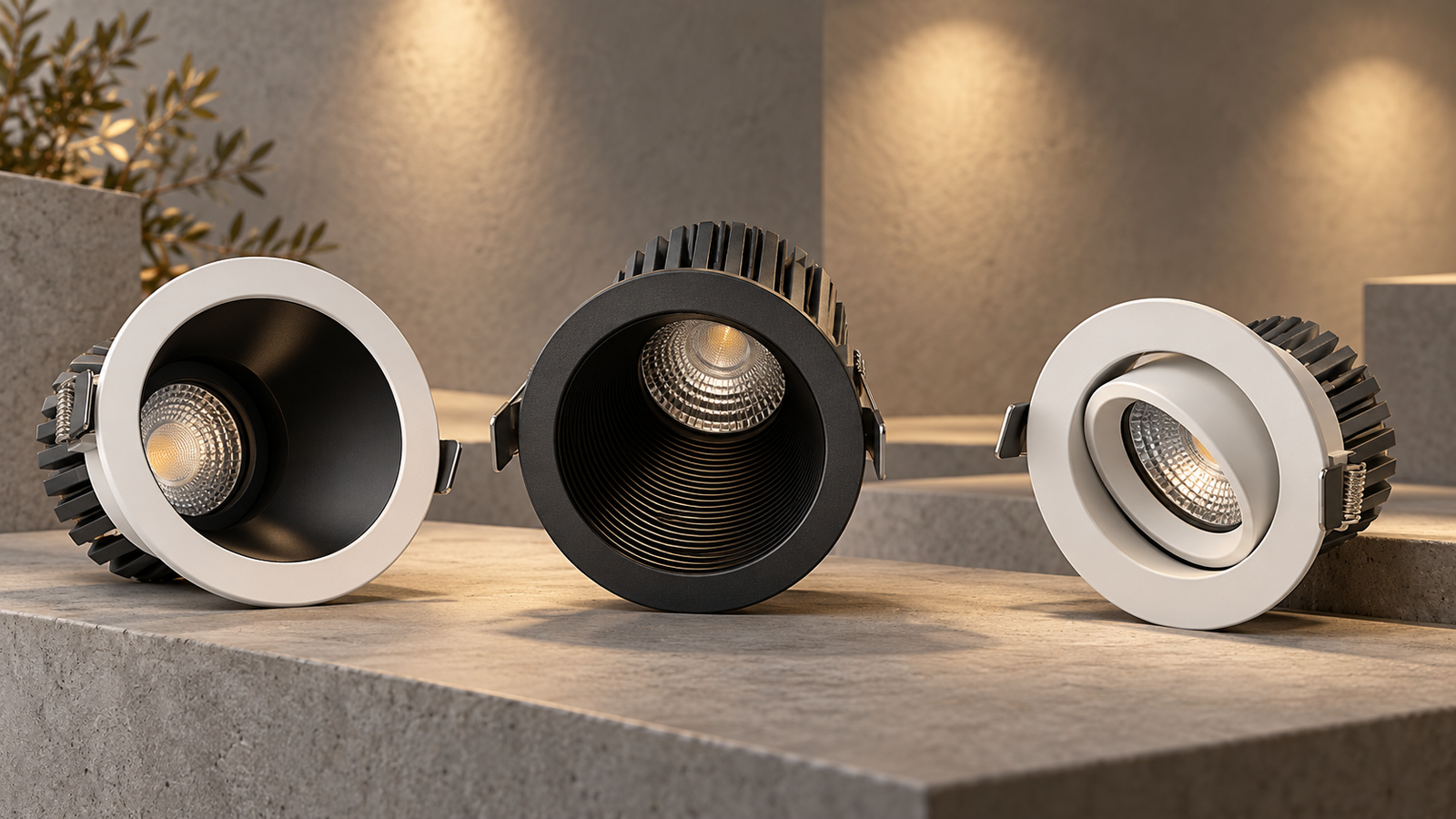
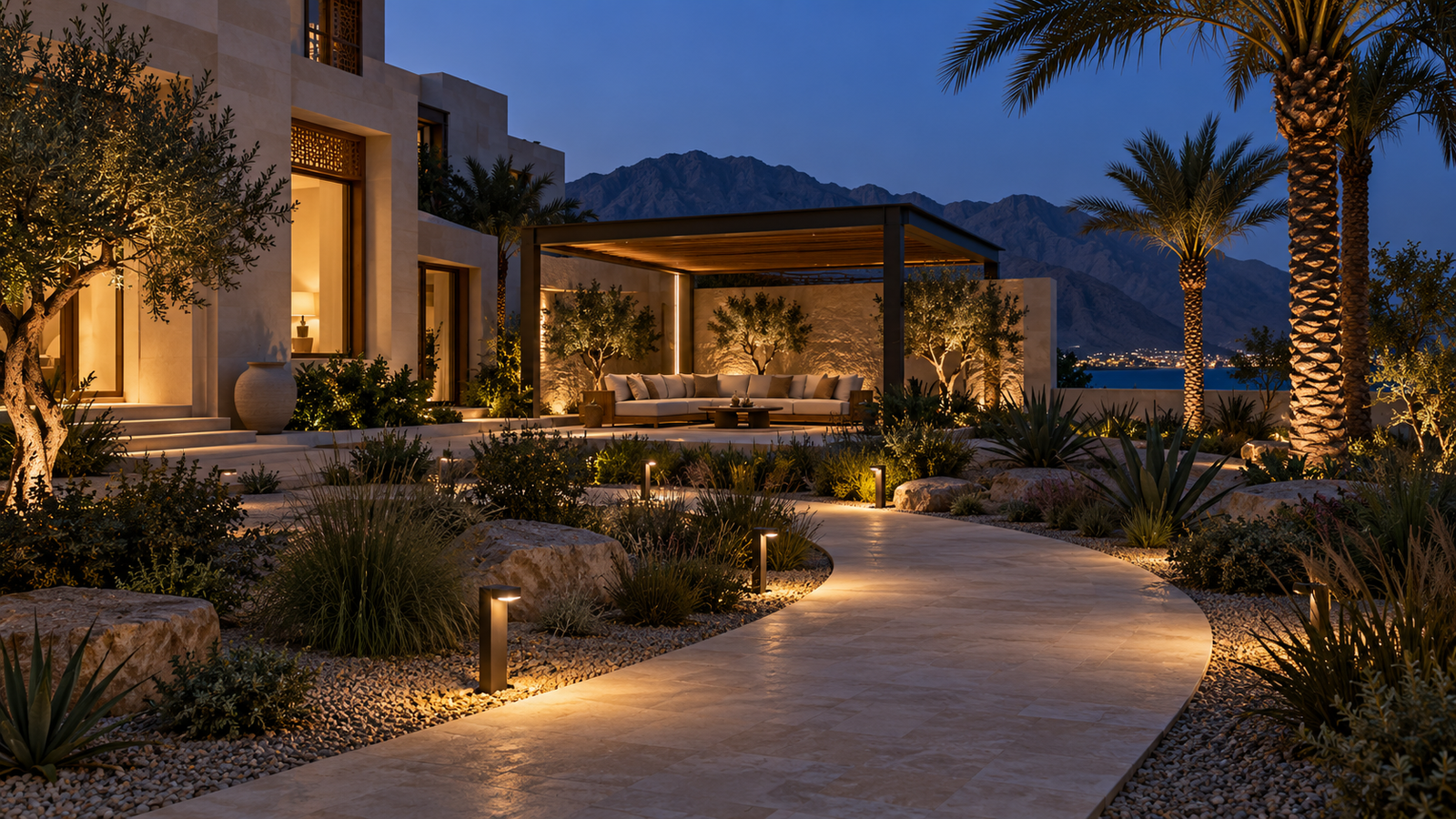
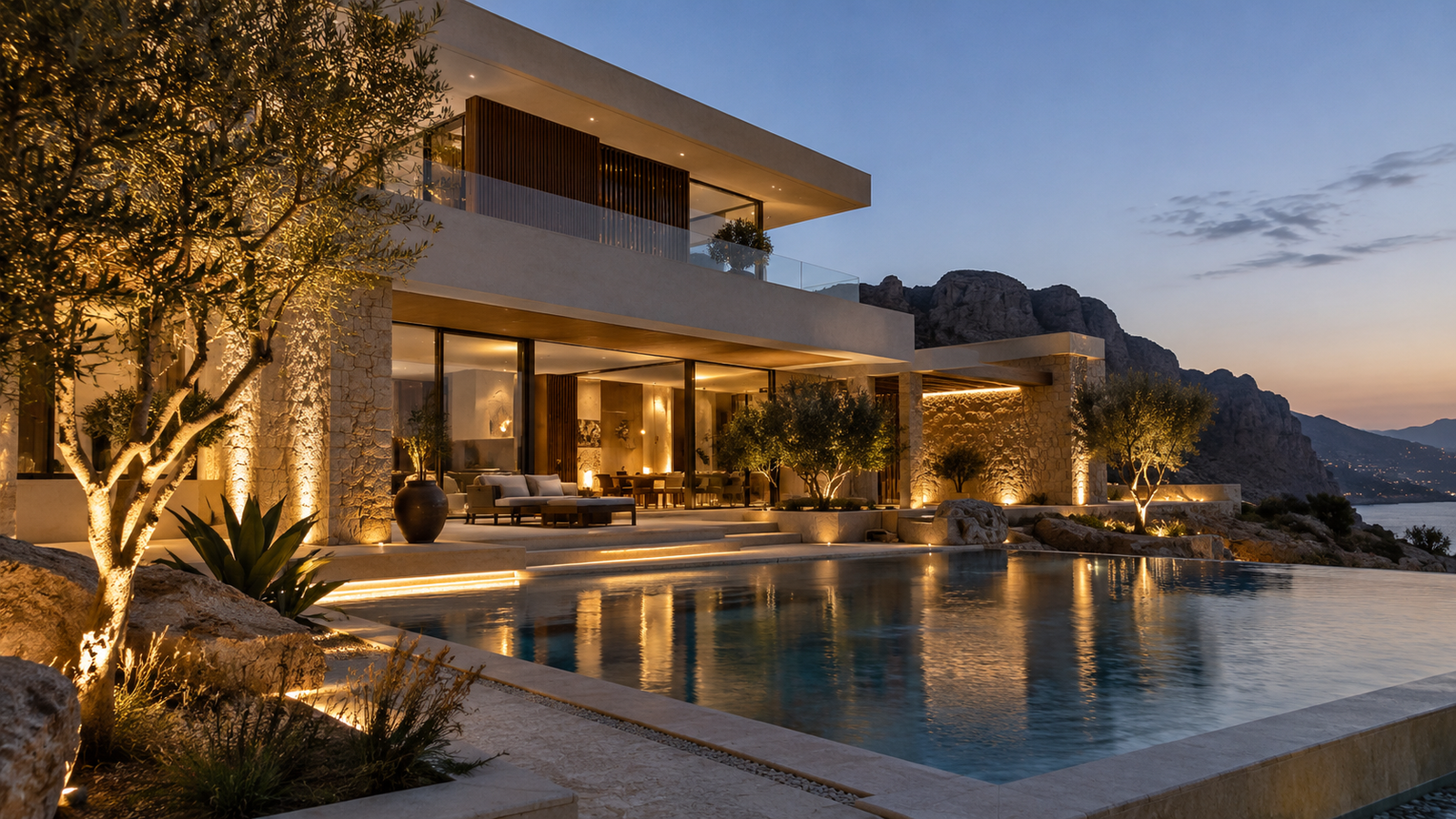
Facade lighting design in Oman is about revealing architectural form, material, depth, and identity while controlling glare, energy use, light spill, and maintenance requirements.
High ambient temperatures, dust, coastal humidity, and the character of local stone and contemporary architecture all influence the final result. A successful scheme should feel integrated with the building, remain comfortable for occupants and neighbours, and perform reliably in demanding outdoor conditions.
What Makes Facade Lighting Effective?
The best facade lighting starts with a clear hierarchy. Not every surface needs equal brightness. Identify the entrance, primary architectural volumes, important textures, vertical elements, landscape edges, and circulation routes. Light can then guide attention through the composition instead of flattening the whole elevation.
Review the facade from the main viewing positions before selecting fixtures. A villa seen from a short driveway needs a different approach from a hotel, mosque, office, or commercial building viewed from a road. Consider mounting locations, viewing distance, surrounding brightness, windows, and neighbouring properties.
Start With the Architecture, Not the Fixture
Every material responds to light differently. Rough stone becomes more expressive when light grazes across it, while smooth plaster may require softer wall washing. Glass, metal, timber, screens, fins, arches, and columns each need a suitable direction, beam angle, and mounting distance.
Use darkness as part of the design. Leaving selected surfaces quieter creates contrast and allows important features to stand out. Covering the complete facade with powerful floodlights can remove depth, increase glare, and waste energy.
Essential Facade Lighting Techniques
Grazing
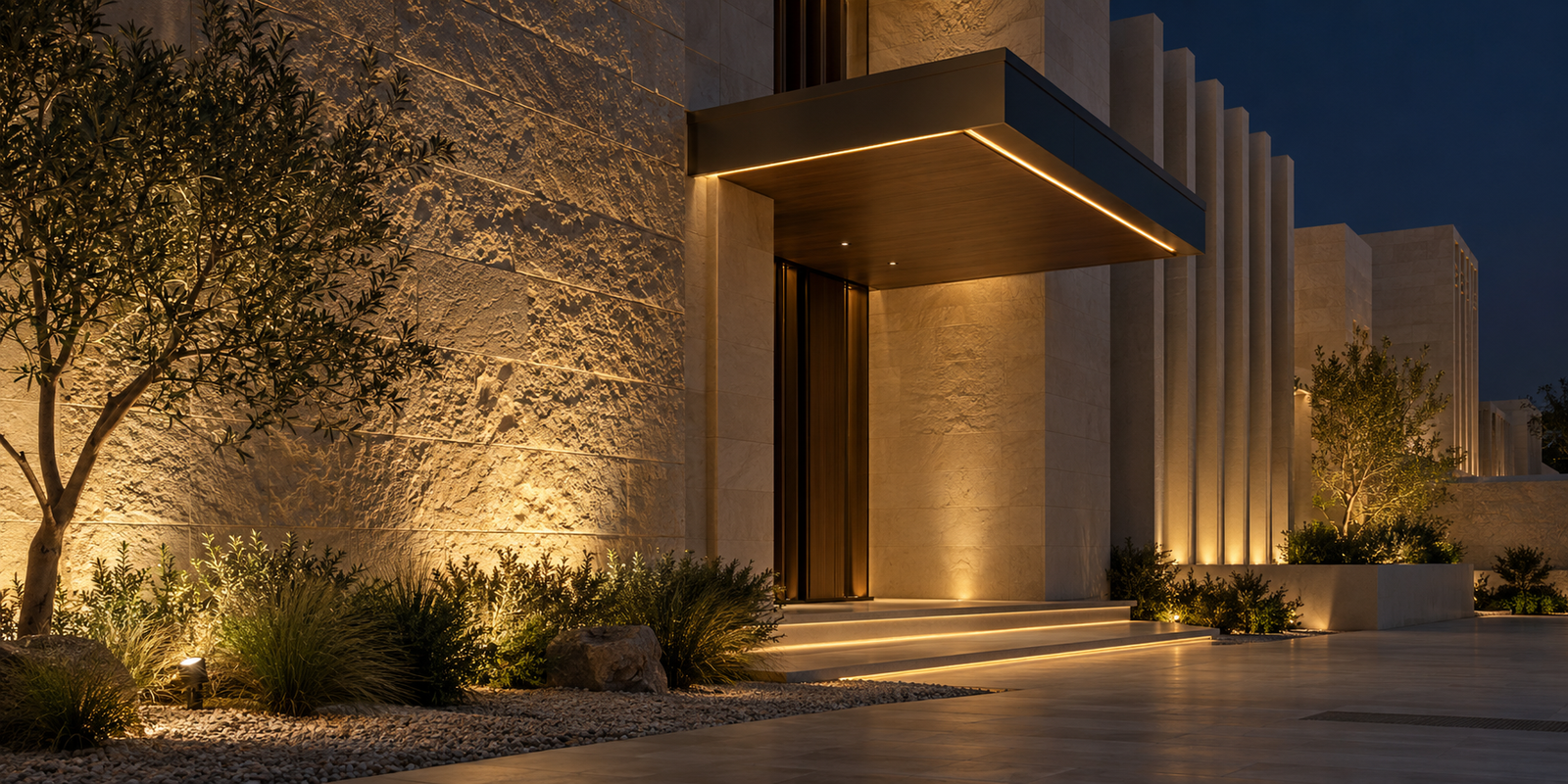
Grazing places the luminaire close to the surface so light travels across it at a shallow angle. It emphasizes texture, joints, relief, and natural variation in stone or brick. Coordinate the mounting position carefully: grazing can also reveal unwanted construction imperfections.
Wall Washing
Wall washing produces smoother, more uniform vertical illumination. The fixture is typically installed farther from the facade than a grazer and uses optics designed to cover the surface evenly. It works well for clean plastered walls, broad entrance volumes, and calm visual backgrounds.
Accent Lighting
Narrow or medium beams can highlight columns, screens, trees, signage, or architectural details. Precise aiming is essential. Illuminate the intended feature without sending direct light into windows, neighbouring properties, pedestrian sightlines, or approaching drivers.
Concealed Linear Lighting
Linear light can define canopies, steps, parapets, screens, and horizontal architectural lines. Conceal the source wherever possible so the viewer sees the effect rather than a bright strip of LEDs. Continuous profiles, consistent colour, thermal management, drainage, and accessible drivers are critical.
Choosing Colour Temperature
Warm white light around 2700K to 3000K often complements limestone, beige plaster, timber, bronze, and landscaped surroundings. Neutral white may suit selected contemporary metal or glass elements. Mixing visibly different colour temperatures without a clear purpose can make the elevation feel fragmented.
Colour rendering and consistency between fixtures also matter. Two products described as 3000K can look different because of their colour tolerance and LED characteristics. Samples and nighttime mock-ups help confirm how the light interacts with the actual material.
Glare and Light Spill
More light does not automatically create a better facade. Unshielded luminaires can become the brightest objects in the scene and make the architecture harder to see. Glare also causes discomfort for occupants, pedestrians, neighbours, and drivers.
Use controlled optics, glare shields, visors, louvers, careful aiming, and suitable mounting positions. Aim light onto the intended surface and limit spill into the sky or through windows. Check any project-specific planning requirements with the relevant authority and consultant.
Outdoor Fixture Selection for Oman
An outdoor rating should match the real installation condition. Exposed wall-mounted luminaires need protection suited to dust and water exposure. In-ground fixtures face additional risks from standing water, irrigation, drainage, cleaning, and physical impact.
IP rating alone is not enough. Evaluate:
- Ambient-temperature limits and driver performance in high heat.
- UV resistance of exposed cables, lenses, seals, and finishes.
- Corrosion resistance for coastal or humid locations.
- Drainage and installation details for recessed ground fixtures.
- Optical control, beam quality, and glare accessories.
- Maintenance access and replaceable drivers.
- Surge protection, connectors, and junction-box sealing.
NORIX combines architectural lighting design with lighting supply, allowing the fixture specification to follow the visual concept and environmental conditions.
Controls, Dimming, and Energy Management
Facade lighting does not need to operate at full output throughout the night. Dimming and scheduling can create an evening scene, a quieter late-night scene, and an automatic off period. An astronomical timer can follow sunset and sunrise throughout the year.
DALI control can provide dimming, grouping, and scene recall when compatible drivers and controllers are specified. Monitoring depends on the capabilities of the selected equipment. KNX building control can coordinate lighting schedules with entrances, sensors, and other integrated systems through suitable interfaces.
For an introduction, read our beginner’s guide to DALI lighting control.
Mock-Ups and Nighttime Commissioning
Drawings and renderings are valuable, but a physical mock-up helps evaluate the actual effect. Test the real material using the proposed fixture, beam angle, colour temperature, mounting distance, and dimming level. This exposes glare, scalloping, unevenness, and unwanted shadows before the full installation.
After installation, aim adjustable fixtures at night. Program and test scenes, dimming levels, timers, and control groups on site. Record final settings and provide maintenance information so the design can be preserved over time.
Common Facade Lighting Mistakes
- Using high wattage as a substitute for optical control.
- Lighting every surface at the same brightness.
- Placing uplights directly below windows without checking spill.
- Ignoring drainage around in-ground fixtures.
- Using one beam angle for every architectural element.
- Mixing colour temperatures and inconsistent LEDs.
- Leaving drivers and junction boxes inaccessible.
- Skipping nighttime aiming and scene adjustment.
A Coordinated Facade Lighting Workflow
A reliable project moves through architectural review, concept development, calculation and visualization, mock-up, fixture selection, electrical and control coordination, shop drawings, installation, focusing, programming, and handover. Starting early helps prevent visible cables, unsuitable recesses, misplaced fixtures, and expensive site changes.
Explore NORIX lighting projects to see how lighting design, products, controls, and execution come together.
Real NORIX Facade and Exterior Lighting Projects
Explore these completed projects for examples of how lighting can reveal architectural edges, stone surfaces, entrances, and outdoor spaces. Each project page identifies the services NORIX provided.
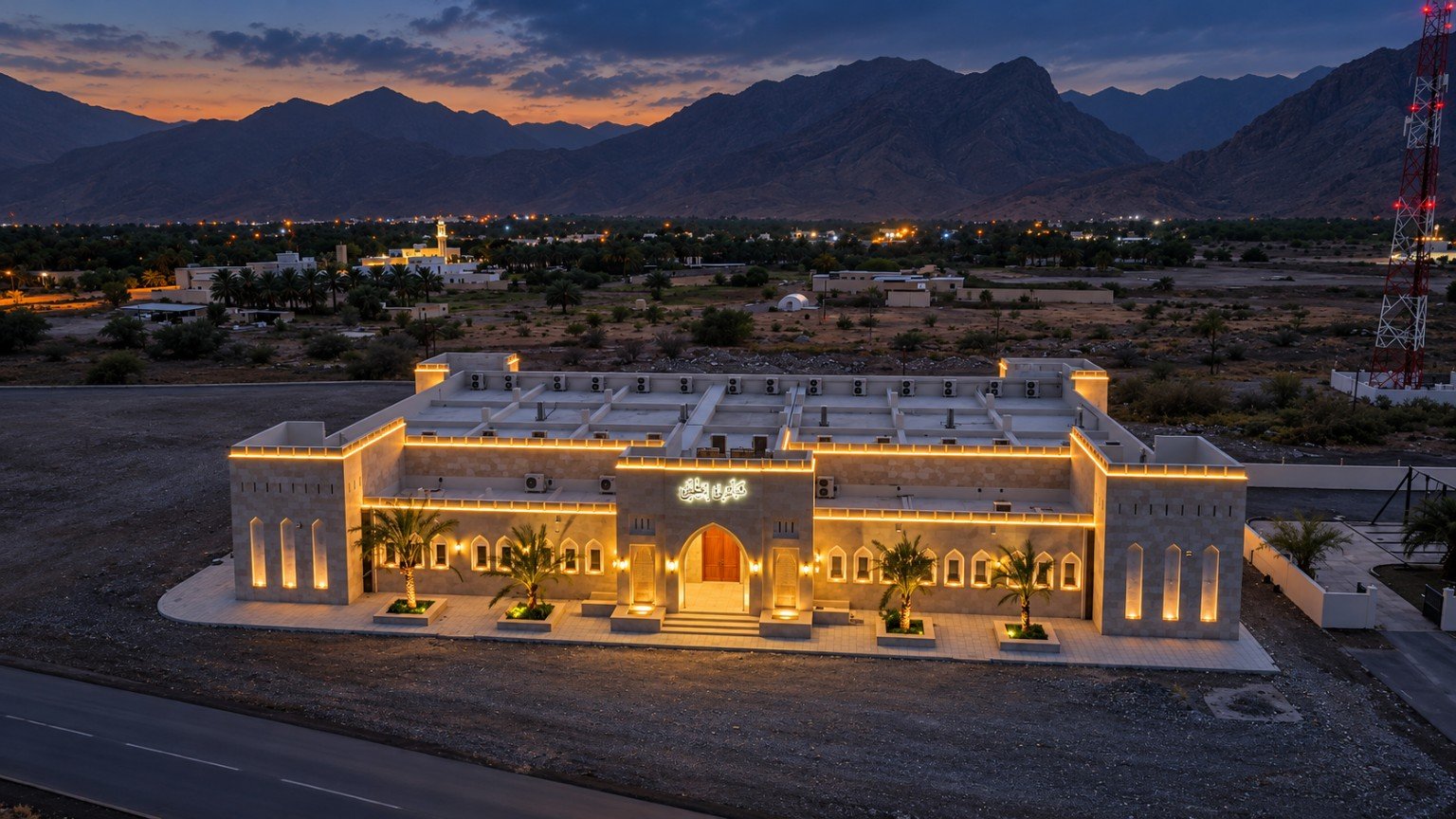
Imti Public Majlis
Warm exterior lighting highlights the stone-clad facade, recessed arches, entrance, and palm-lined frontage. NORIX provided architectural lighting design and lighting supply. View the Imti Public Majlis project.
Private Villa — Al Khoudh, Muscat
This residential project brings together interior, facade, and landscape lighting. NORIX provided architectural lighting design, lighting supply, and lighting installation. Explore the Al Khoudh villa.
Private Residence — Ibri
Illuminated architectural edges and stone surfaces shape the courtyard after sunset. NORIX provided interior and exterior lighting design and lighting supply. View the original project photograph and scope in Ibri.
Frequently Asked Questions
Which colour temperature works best for a villa facade?
2700K or 3000K is often a useful starting point for warm stone and plaster finishes. Confirm the choice with a sample on the actual surface; material colour and surrounding lighting affect the result.
Is an IP rating enough to choose an outdoor light?
No. Check temperature limits, corrosion resistance, optics, electrical protection, drainage, and installation instructions as well as the IP rating.
Can facade lighting be controlled with DALI and KNX?
Yes, with compatible luminaires, drivers, gateways, and control equipment. Define the desired scenes, schedules, and feedback before selecting the system.
Planning Facade Lighting in Oman?
Whether the project is a villa, hotel, mosque, office, retail building, or mixed-use development, lighting should reflect the architecture. Contact NORIX Lighting Ideas to discuss concept design, calculations, mock-ups, product selection, controls, installation, and commissioning.