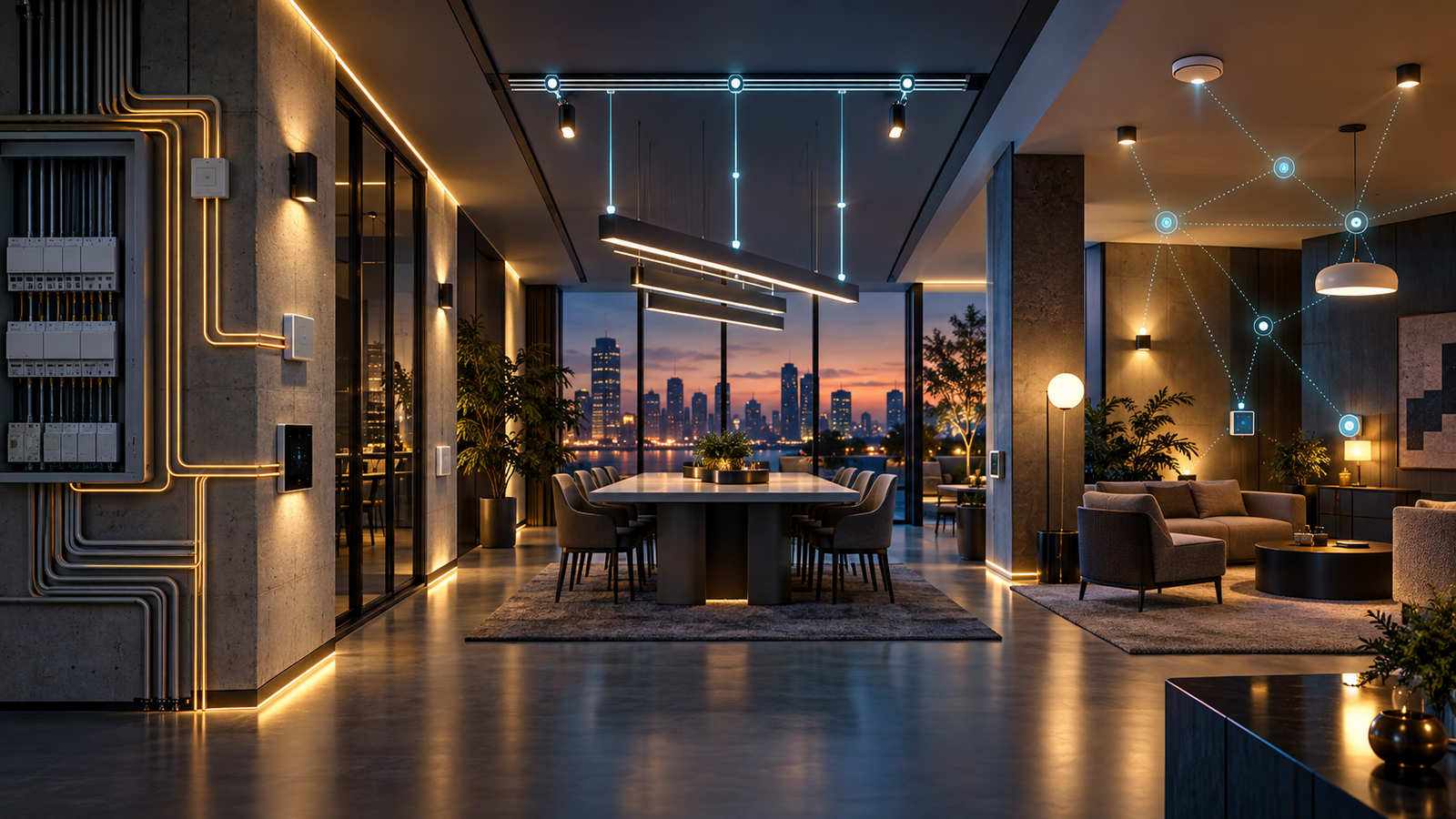
DALI lighting control is a digital system for addressing, dimming and monitoring compatible lighting equipment. DALI stands for Digital Addressable Lighting Interface; commands travel over a shared two-wire control bus.
Instead of controlling only fixed electrical circuits, you can control individual drivers, change lighting groups in software and recall scenes. The features available depend on the drivers, controller and configuration.
See it in action: try individual lights, groups and scenes in our interactive DALI demo →
How Does DALI Lighting Control Work?
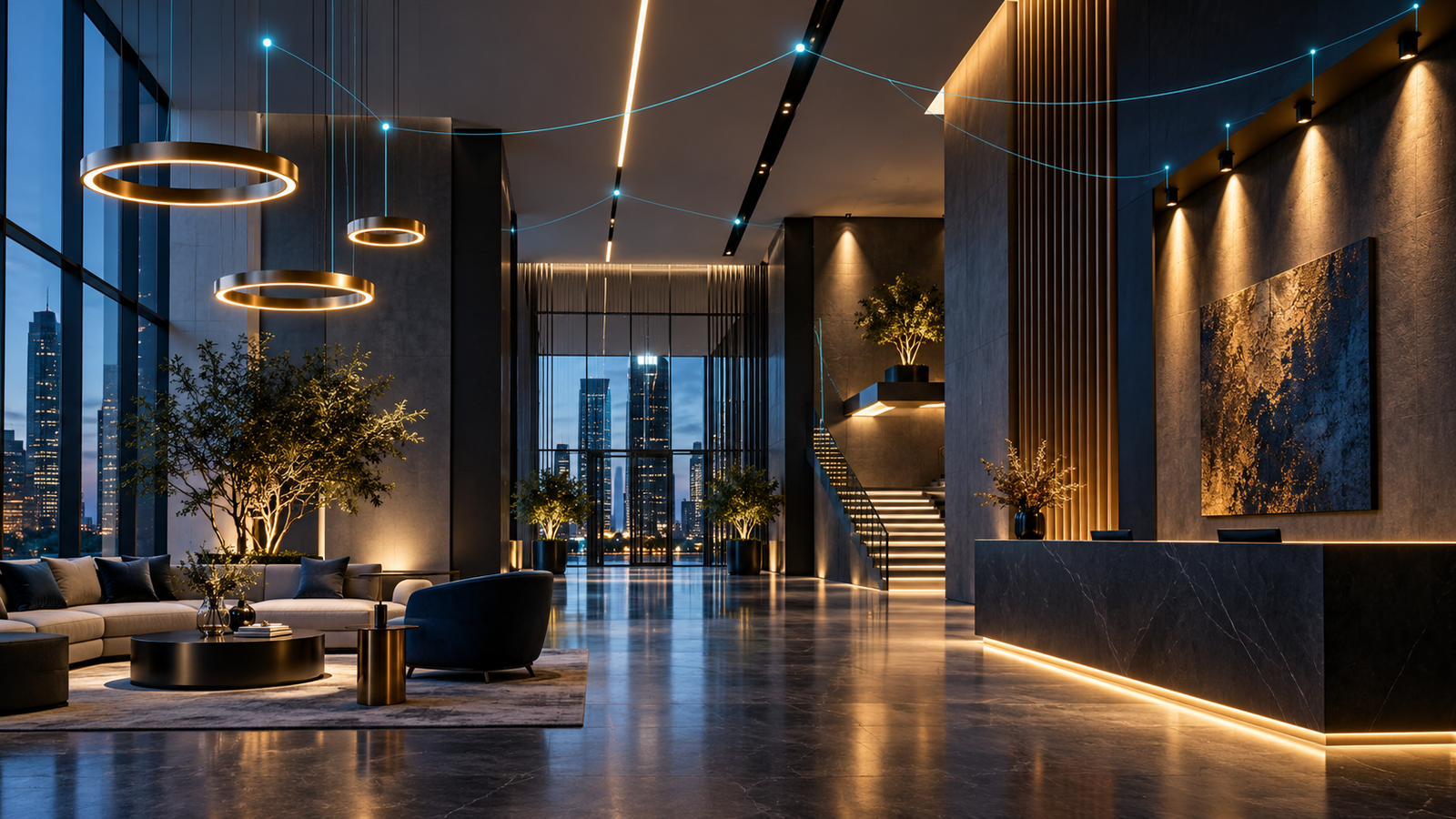
A DALI system normally includes compatible control gear, a two-wire DALI bus, a bus power supply and an application controller. Depending on the design, it may also include sensors, push-buttons, gateways and management software.
The controller sends digital commands across the bus. Because devices can be individually addressed, one fitting can respond differently from another even when both are connected to the same normal power circuit.
The Main Components of a DALI System
What Is a DALI LED Driver?
A DALI LED driver powers the LED light source and responds to digital commands from the control bus. It is a type of control gear; other examples include emergency and colour-control gear. A standard non-DALI driver cannot be assumed to accept DALI commands.
Application Controller
The application controller contains the system logic. It processes information from keypads, sensors, schedules or a building-management gateway and sends commands to the lighting devices.
DALI Bus Power Supply
The communication bus requires a suitable DALI power supply. Bus loading, voltage drop and the number of power supplies must be coordinated according to the selected system architecture.
Input Devices
In DALI-2 systems, certified input devices can include push-buttons, occupancy sensors and light sensors. The application controller must support the relevant device types and required functions.
Gateways
A gateway connects DALI lighting to a wider control platform such as KNX or a building management system. Selection depends on the number of DALI lines, required feedback, emergency functions and colour-control features.
What Can DALI Control?
- Individual luminaire addressing
- Software-defined lighting groups
- Stored lighting scenes
- Switching and smooth dimming
- Tunable-white and colour control with compatible DT8 equipment
- Occupancy and daylight-based control
- Device status and fault feedback
- Self-contained emergency-lighting testing with compatible DT1 equipment
- Energy and diagnostic data with suitable D4i devices
Not every DALI product supports every feature. The driver, input device, application controller and software must be checked as one complete system.
DALI Addresses, Groups and Scenes: A Simple Example
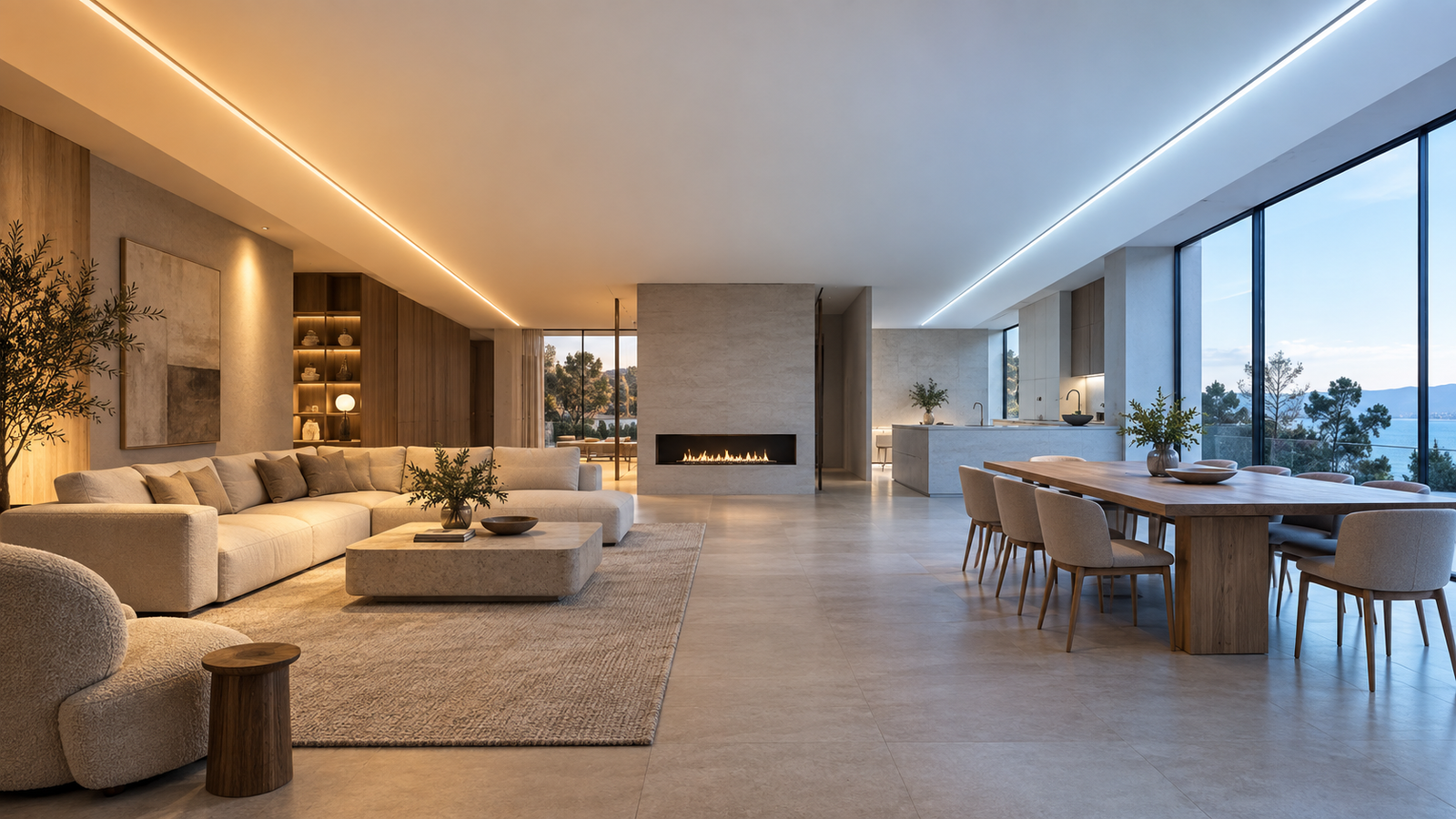
Individual addressing allows a commissioning engineer to identify and control each compatible item of control gear. Devices can then be assigned to logical groups without changing the power wiring.
A scene stores defined light levels for multiple devices. A conference room, for example, may have separate Presentation, Discussion, Video Call and Cleaning scenes recalled from a keypad, touchscreen or building-automation command.
Example: six downlights in a meeting room can have six separate addresses. Put the lights above the table in one group, then store a Presentation scene with different levels for the table and screen area. The group describes which devices respond; the scene stores how they should look.
DALI Wiring Basics
The DALI bus carries communication and bus power; it does not replace the electrical supply that powers the LED light source. DALI uses a two-wire communication bus. The bus can usually be routed alongside mains conductors when the selected cable, insulation and installation method meet applicable electrical requirements.
DALI supports flexible bus arrangements such as daisy-chain, star and tree combinations. A closed ring should be avoided. The designer must also consider cable length, conductor size, voltage drop, bus current and segregation requirements.
DALI Line Capacity
In a DALI-2 system, a line can support up to 64 control-gear addresses and up to 64 control-device addresses, subject to the controller, bus-power and current requirements. Large buildings use multiple lines connected through controllers or KNX/DALI gateways.
What Is the Difference Between DALI, DALI-2 and D4i?
DALI Version-1
Earlier DALI systems focused mainly on control gear. Product registration and testing existed, but system-level interoperability—especially for control devices—was less comprehensive.
DALI-2
DALI-2 extends certification and testing across more parts of the system, including application controllers and input devices. Certified products can be verified in the DALI Alliance product database.
D4i
D4i builds on DALI-2 for intelligent, connected luminaires. Compatible devices can store luminaire data and provide standardised energy or diagnostic information.
DALI and Dimming: Are They the Same?
No. Dimming is only one function. DALI is a digital lighting-control platform that can also provide addressing, regrouping, scenes, feedback, sensors, colour control, emergency testing and data.
For a deeper explanation, read DALI Is More Than Dimming: 10 Capabilities You Should Know.
DALI vs 0–10V Dimming
0–10V is an analogue control method. Luminaires connected to the same control pair normally follow the same signal, and the system does not inherently provide digital addressing or detailed feedback.
DALI uses digital commands, allowing individual addresses, software groups and two-way communication. 0–10V may suit straightforward zones, while DALI is often more appropriate when flexibility, scene control, feedback or integration is required.
DALI vs KNX
DALI specialises in lighting at the luminaire level. KNX is a wider building-control standard that can coordinate lighting, HVAC, curtains, sensors, energy functions and user interfaces.
Many professional projects use both: DALI controls luminaires while KNX provides room logic and integration. See our comparison of KNX, DALI and Zigbee.
Where Is DALI Commonly Used?
- Hotels and hospitality projects
- Offices and commercial buildings
- Retail stores and showrooms
- Luxury villas and residences
- Schools, healthcare and public buildings
- Façade and architectural lighting
- Projects requiring monitored emergency lighting
Common DALI Design Mistakes
- Treating DALI as only a dimming cable
- Exceeding line capacity or available bus current
- Assuming all controllers support every DALI-2 input device
- Mixing DT8 drivers with incompatible controllers
- Ignoring emergency-device testing and reporting requirements
- Using inconsistent naming and undocumented addresses
- Failing to keep an updated commissioning backup
Does DALI Work Without KNX?
Yes. DALI can operate as a standalone lighting-control system when it has a suitable application controller and user interfaces. KNX is added when wider building integration or unified logic is required.
Is DALI Suitable for Villas?
DALI can be valuable in villas with many dimmed circuits, architectural scenes, tunable white or KNX integration. For a small project with only a few simple switched circuits, it may add unnecessary cost and commissioning effort.
Final Recommendation
DALI is a flexible, standardised approach to professional lighting control. Its real value comes from digital addressing, configuration, feedback and integration—not dimming alone.
Based in Muscat, Oman, NORIX supports DALI and KNX lighting-control projects across the GCC, with design, supply, programming and commissioning coordinated to the agreed project scope. Explore our Smart Lighting & Home Control service or contact NORIX before the electrical and control architecture is finalised.
Technical references: DALI Alliance protocol features, systems and components, device types and D4i overview.