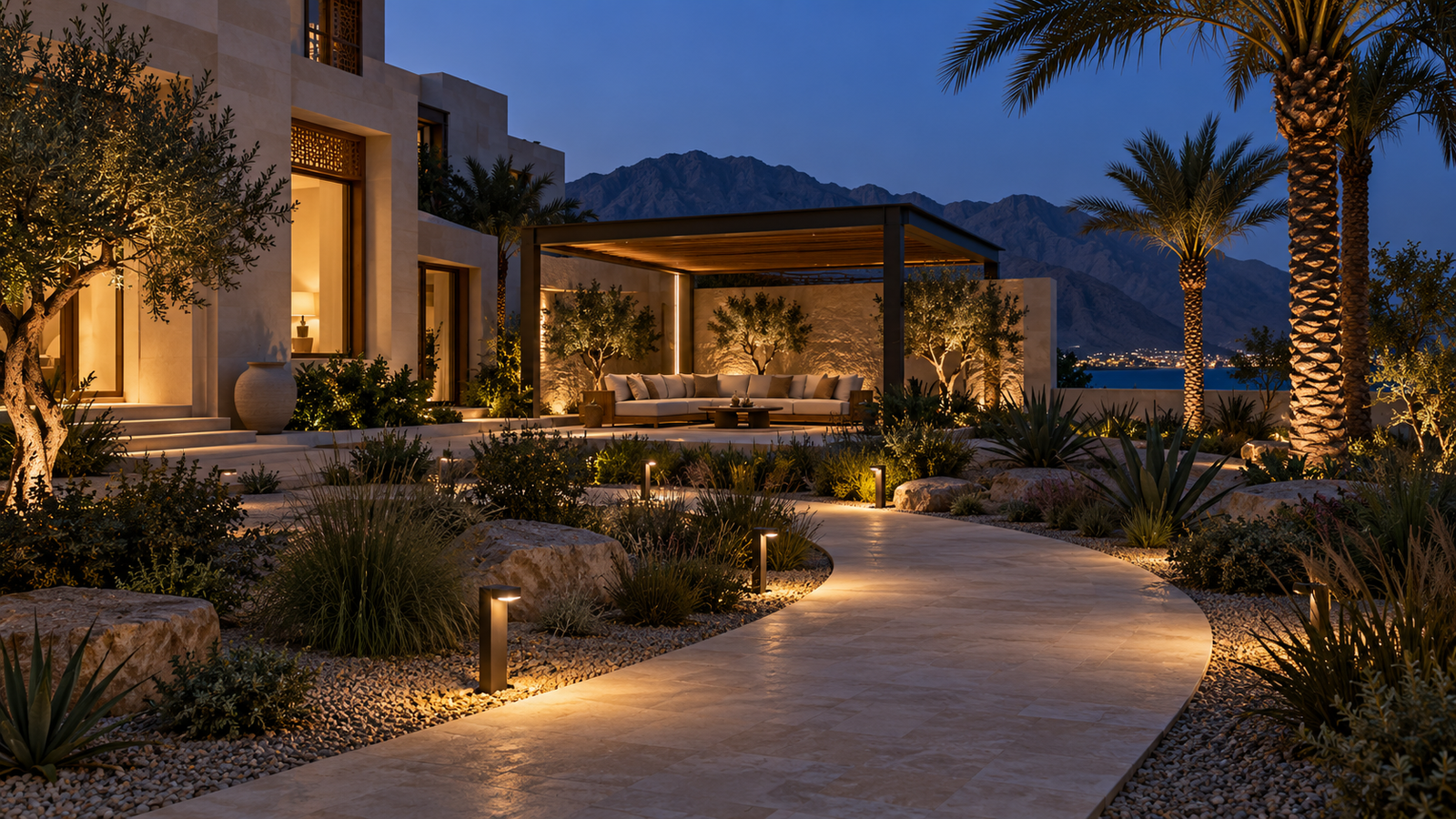
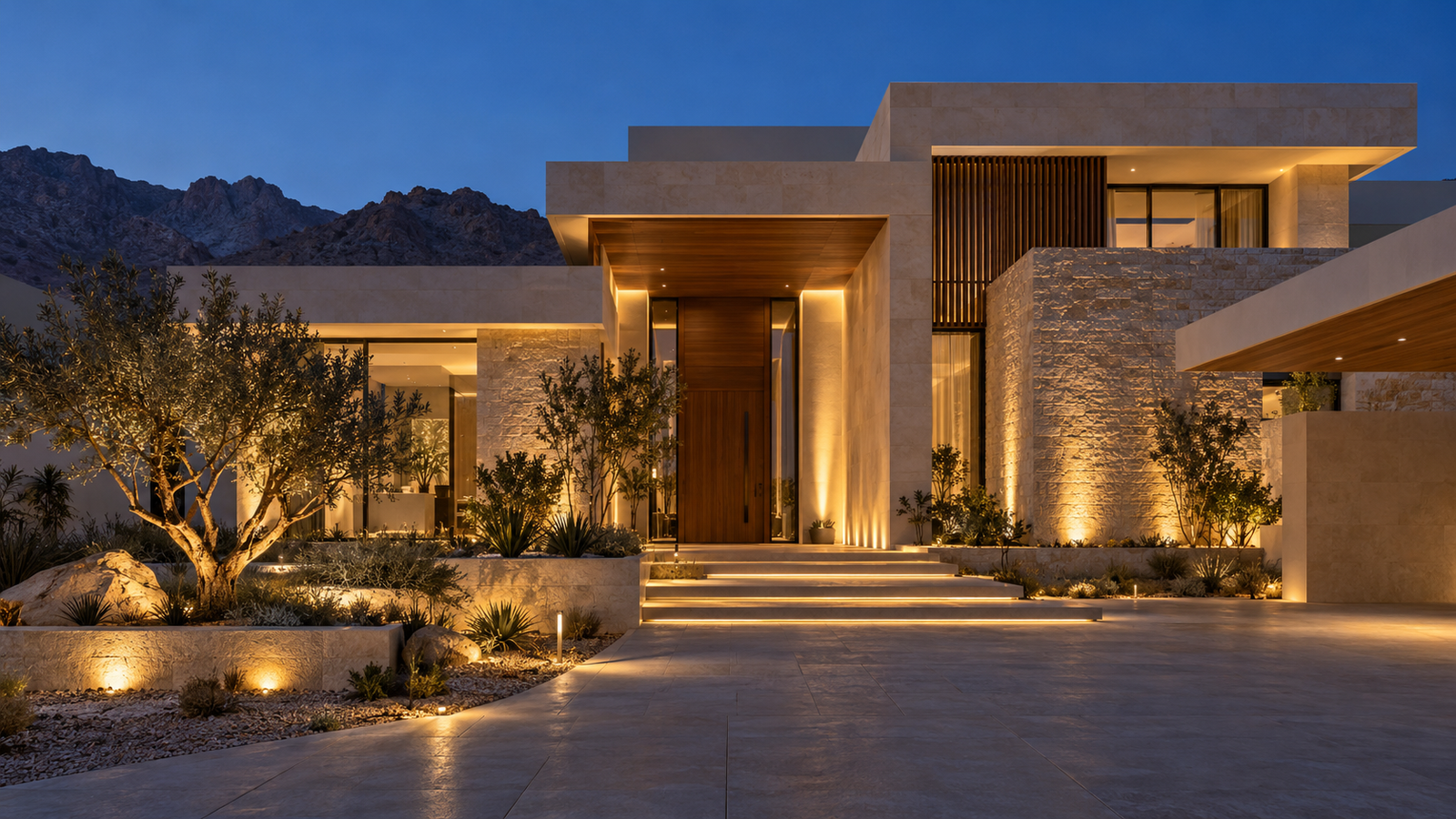
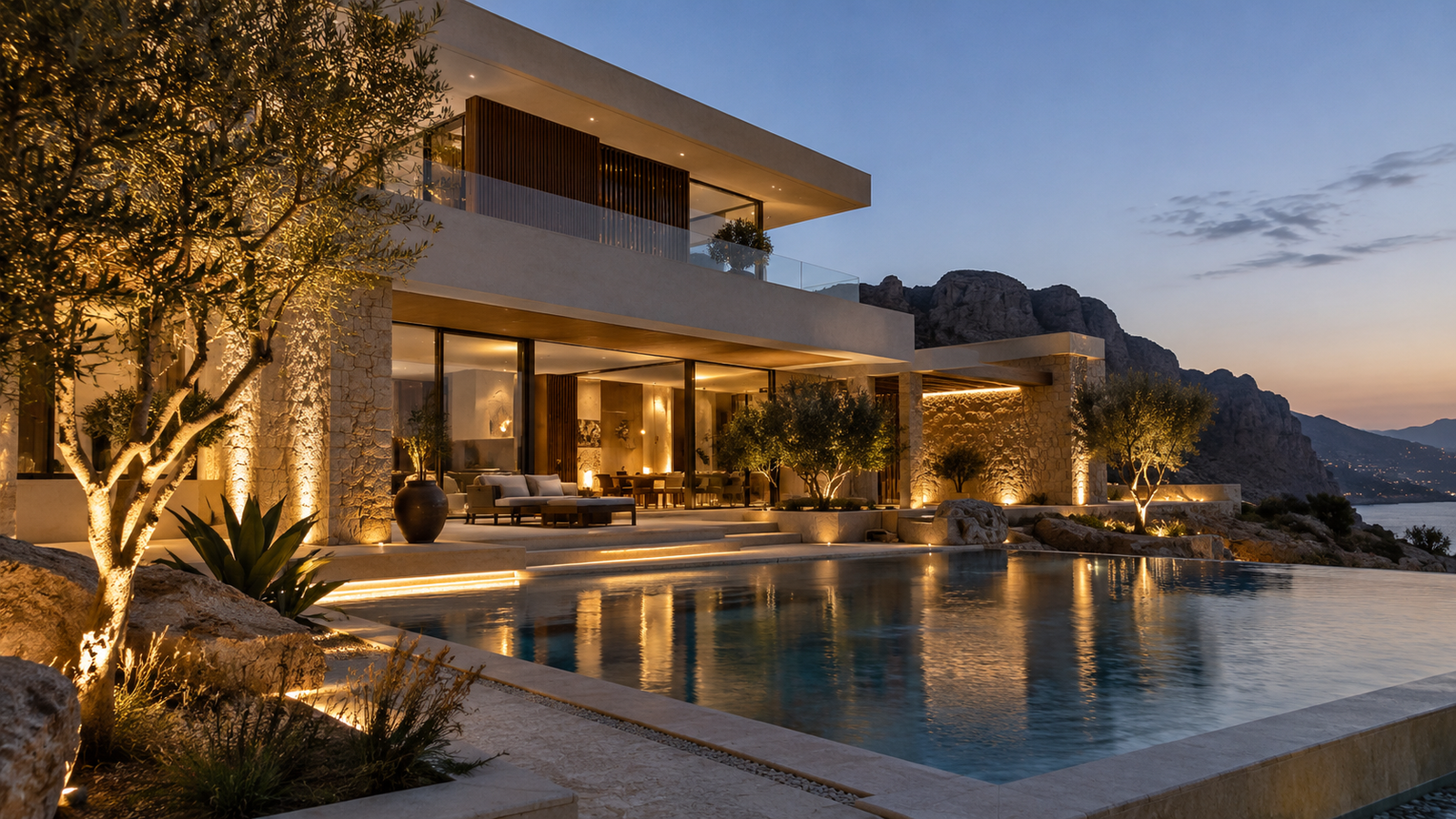
Choosing LED downlights involves more than selecting a wattage and a ceiling finish. The right fitting needs to deliver light where it is useful, remain comfortable to look towards, reproduce colours well, and work with the intended controls.
This guide explains how to choose LED downlights for villas, offices, hospitality, and retail projects in Oman. Start with the room, ceiling height, materials, furniture, and activities before comparing product specifications.
Start With the Lighting Task
Decide whether the fitting will provide general illumination, light a worktop, highlight artwork, or reveal a wall. A single type of downlight rarely performs all these tasks equally well.
Fixed downlights suit downward illumination. Adjustable fittings help aim light onto selected features. Dedicated wallwashers are designed for vertical surfaces and should not be confused with an ordinary downlight placed close to a wall.
For room-by-room planning, see our villa lighting design guide for Oman.
Watts, Lumens, and Lux: What Is the Difference?
- Watts describe electrical power consumption.
- Lumens describe the amount of light emitted.
- Lux describe light arriving on a surface.
Two 12W fittings can have different light output, beam distributions, and visual comfort. Compare the complete luminaire’s output, not only the LED chip’s advertised lumens. Optical losses and operating conditions affect the result.
A lighting calculation uses photometric data, room geometry, reflectance, and maintenance assumptions to estimate illumination. Choose the output to support the task rather than buying the highest wattage available.
Beam Angle: Match the Spread to the Purpose
A narrow beam concentrates light on a smaller area. A wider beam spreads it across a larger area. For comparable output, the narrow beam generally produces greater intensity near its centre; it does not necessarily emit more total light.
Beam angle is commonly defined at half the peak luminous intensity. Light can continue beyond that angle, so the beam edge is not a sharp boundary.
| Illustrative beam | Typical design starting point | What to check |
|---|---|---|
| 15°–24° | Focused accents and selected details | Aiming, contrast, and hotspot intensity |
| Approximately 36° | More localised pools of light | Coverage and overlap at the target surface |
| Approximately 60° or wider | Broader illumination | Uniformity and glare control |
These are starting points, not universal specifications. Beam quality, ceiling height, furniture, and the actual photometric distribution matter as much as the nominal angle.
Why Ceiling Height Changes the Result
For a centred, symmetrical beam striking a perpendicular surface, an approximate beam diameter is 2 × distance × tan(beam angle ÷ 2). At a 2.5m distance, a 36° beam has an approximate diameter of 1.62m. This geometric estimate does not describe uniformity, spill light, or the illumination level.
Measure the distance to the working surface, not automatically to the floor. Do not use beam diameter alone to set fixture spacing.
Glare: Look Beyond an “Anti-Glare” Label
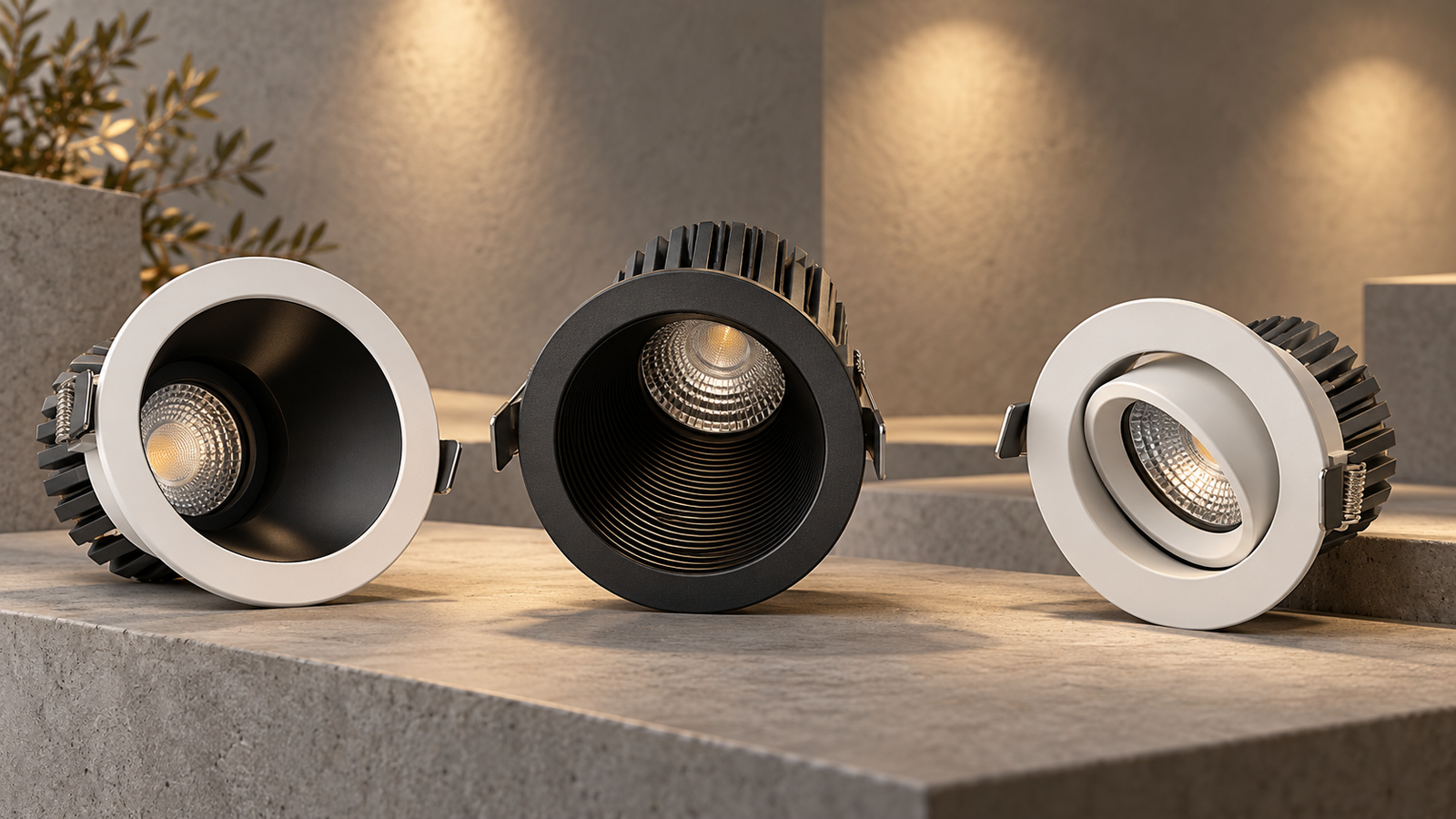
A deeply recessed source, suitable baffle, shielding, and controlled optics can limit direct views of bright components. However, a dark inner cone alone does not guarantee comfortable light.
Review the fitting from seated positions, beds, circulation routes, and screen locations. Check reflections on glossy surfaces as well as direct glare. An adjustable light needs to remain comfortable after it has been aimed.
A claimed UGR value should be read with its calculation conditions. UGR depends on the installation and viewing geometry; a product label does not guarantee the same result in every room.
Colour Temperature and Colour Rendering
Colour temperature describes the appearance of the white light. Warm white around 2700K or 3000K is often a useful starting point for residential settings, while 4000K may suit some work environments. Confirm the effect on the actual finishes and coordinate adjacent spaces.
CRI describes colour fidelity compared with a reference source. CRI 90 or above is a useful starting preference where appearance matters, but the general CRI value does not fully describe saturated reds. Ask about R9 and, where available, TM-30 data.
CRI and colour temperature answer different questions: a 3000K fitting can still have poor colour rendering. Compare samples using skin tones, timber, textiles, and artwork.
Colour consistency also matters. Ask for the stated SDCM tolerance and consistent product batches. Two fittings labelled 3000K may differ visibly in tint.
The Driver Determines More Than Switching
The driver needs to match the LED module’s electrical requirements. For constant-current fittings, check the rated current, output-voltage range, power, and thermal limits. Matching wattage alone is insufficient.
Choose the control method before ordering. A phase-cut dimmable driver, an analogue dimming driver, and a DALI driver are different specifications. “Dimmable” does not mean compatible with every dimmer.
Test the complete driver and controller combination for minimum dimming level, smooth fading, start-up behaviour, flicker, and audible noise. Low-level performance is particularly noticeable in bedrooms and evening scenes.
With suitable drivers and gateways, DALI lighting can integrate with KNX. Read our DALI guide and explore NORIX smart lighting and home control.
Trimmed, Trimless, and Adjustable Fittings
Trimmed fittings provide a visible ceiling edge and can simplify installation or replacement. Trimless fittings need early coordination with plastering, mounting frames, and ceiling finishes. Check the installation sequence before the ceiling is completed.
Confirm cut-out size, recess depth, driver access, tilt range, and clearances. Keep insulation away where the manufacturer requires it. Thermal conditions above the ceiling affect both the LED and driver.
For bathrooms or exposed areas, choose protection suited to the location and applicable electrical requirements. An indoor fitting should not be assumed suitable for outdoor use because it has a similar appearance.
What to Ask Before Ordering LED Downlights
- What is the complete luminaire output and input power?
- Are IES or LDT photometric files available?
- Which beam distributions and glare accessories are offered?
- What are the CCT, CRI, R9, and colour-consistency specifications?
- Which driver and control method are included?
- What dimming range has been tested with the selected controller?
- What cut-out, depth, thermal clearance, and access are required?
- What warranty, replacement, and maintenance support is available?
Frequently Asked Questions
Is a higher-wattage downlight always brighter?
No. Compare luminaire lumens and photometric data. More electrical power does not automatically deliver better useful illumination.
Is a 36° beam suitable for every room?
No. It may suit some tasks and accents, but broad illumination or wall lighting may need different optics.
Can I add DALI later?
It depends on the installed drivers, wiring, and access. Plan the control system before ordering to avoid replacing equipment later.
Choose Downlights With the Design in Mind
NORIX Lighting Ideas coordinates architectural lighting design, lighting supply, and controls. Contact NORIX with your ceiling plan, room uses, and control requirements for project-specific selection.
Further reading: U.S. Department of Energy: LED basics and colour quality; DALI Alliance product database.